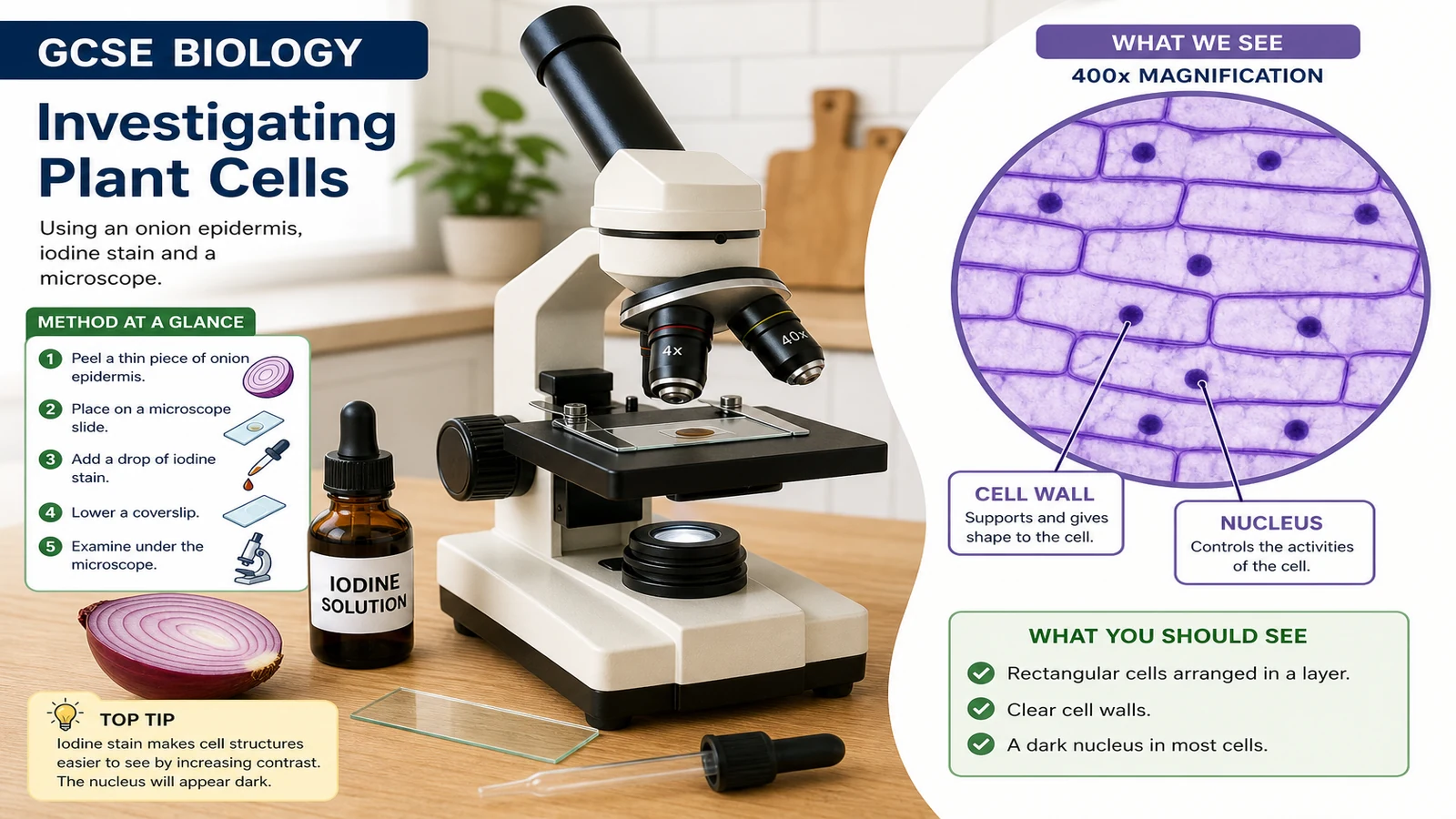
GCSE onion cells microscope 400x home UK: AQA RP01 pitfalls and kitchen checklist
Searching gcse onion cells microscope 400x home uk usually means your child missed the school practical or wants revision before a mock. AQA GCSE Biology required practical work expects students to observe plant cells with a light microscope, produce a labelled scientific drawing, and calculate magnification. BBC Bitesize lists high power as a 40× objective with a 10× eyepiece, giving 400× total—exactly where cell walls and nuclei become clear in onion epidermis.
What the practical is trying to teach
Onion epidermis is a classic because the cells are large, regular, and stain well with iodine. The skill is not memorising a photo—it is preparing a flat mount, finding tissue on low power, switching objectives without crushing the sample, and recording scale honestly. Edexcel and Pearson specifications include similar core practical language about investigating plant and animal cells with a light microscope; always check your exam board wording, but the 400× workflow is widely taught.
Materials for a UK kitchen bench
- Fresh onion (red or white)
- Dropper bottle of iodine solution—or Lugol’s from a school kit
- Microscope slides and coverslips
- Compound microscope with 4×, 10× and 40× objectives
- Paper towel, forceps or tweezers, and a sharp knife with adult supervision
Five-step mount that survives 400×
- Cut the onion, peel a thin transparent layer from inside a layer segment.
- Place the peel flat on a slide; add one drop of water so it does not fold.
- Add one drop of iodine at the edge; let it diffuse under the tissue—avoid flooding the whole slide brown.
- Lower a coverslip at an angle to push bubbles to the side.
- Locate cells on 4× or 10×, centre the field, then rotate to 40× using fine focus only.
Where home attempts go wrong
Crushing the peel with a rushed coverslip is the most common failure—cells look torn instead of brick-like. Too much iodine obscures the nucleus. Using coarse focus on high power blurs then scratches the slide. For GCSE marks, students also lose credit when drawings omit a scale bar or magnification line. Write total magnification as eyepiece × objective, e.g. 10 × 40 = 400×.
AT7-style check before you pack away
- Drawing shows contiguous cell walls and at least one nucleus
- Labels use straight lines without arrowheads crossing cells
- Magnification calculation shown next to the drawing
- No shading inside cells unless your teacher explicitly allows it
Pair with animal cell work
Once onion cells work, repeat the workflow with cheek epithelium and methylene blue in our cheek cell slide guide. Compare monocular comfort for short sessions in monocular vs binocular for GCSE.
Who does not need a home microscope
If school practicals already cover RP01 and the student only needs past-paper maths, borrowing lab time is enough. Buy or hire home kit when repeated evening revision helps or when coursework catch-up is urgent.
See the monocular compound listing
AdultMonoc sells a monocular biological compound microscope at £60.99 on the live product page. We do not claim bundled iodine or prepared slide kits—confirm box contents on the product page before ordering.
Is 400× the same as “high power” in textbooks?
Yes in most UK GCSE resources: 40× objective multiplied by a 10× eyepiece.
Can iodine stain clothes?
Yes. Work over a tray, wear an apron, and wash spills promptly.
Do I need oil immersion for onion?
No. 400× is the standard working magnification for epidermal cell walls and nuclei.