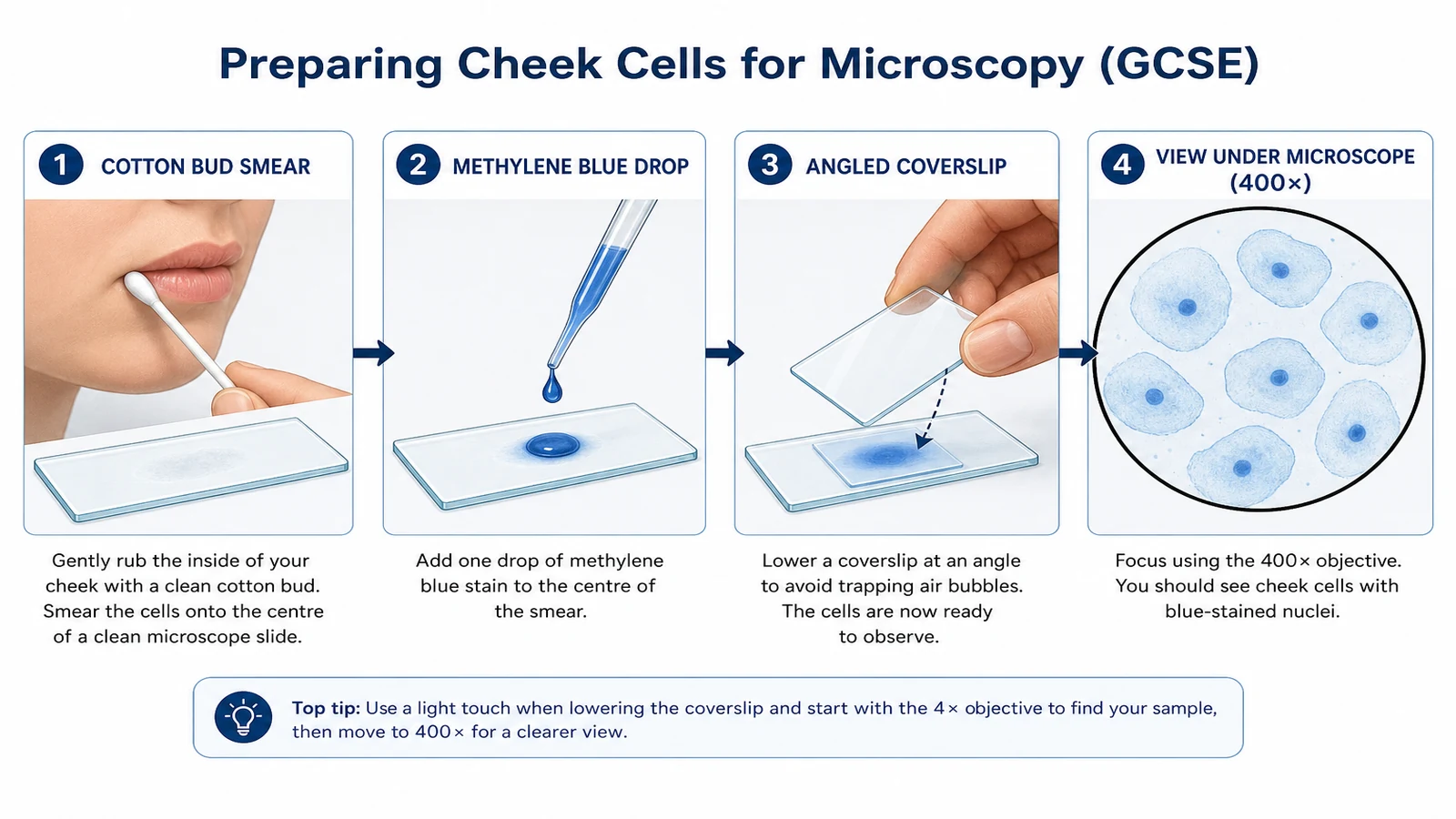
How to prepare cheek cells slide GCSE UK: cotton bud to 400× nucleus detail
If you need how to prepare cheek cells slide gcse uk, you are probably bridging school practical gaps at the kitchen table. BBC Bitesize describes smearing cheek epithelium onto a slide, staining with methylene blue, covering with a coverslip, and observing at up to 400× where the nucleus stands out against the cytoplasm. Pearson Edexcel GCSE Biology core practical language similarly expects students to investigate animal cells with a light microscope—this walkthrough follows that public pattern without replacing supervised school labs.
What you need on the bench
- Sterile cotton buds—one per person
- Clean microscope slides and coverslips
- Methylene blue stain (dilute according to kit label)
- Compound microscope with 4×, 10× and 40× objectives
- Disposable gloves, paper towel, and a biohazard bag for used swabs
Step sequence that works at 400×
- Wash hands, then gently scrape the inside of the cheek with a cotton bud for two to three seconds.
- Roll the bud across the centre of a dry slide to leave a thin smear—do not flood with water first.
- Add one drop of methylene blue; wait 30–60 seconds, then blot excess from the edge with tissue.
- Place a coverslip carefully to avoid air bubbles over the smear.
- Find cells on low power, centre, switch to 40× objective with a 10× eyepiece for 400× total.
Why the magnification path matters
Cheek cells are large but easy to miss if the smear is too thick. Use 4× to locate the hazy sheet, 10× to pick an uncrowded cluster, then 400× for nucleus shape. Jumping straight to high power with coarse focus smears the stain and frustrates beginners. Total magnification is eyepiece × objective; write it on your drawing.
Labelling and hygiene expectations
GCSE marks reward clear outlines, nucleus labelled, and no artistic shading inside cells unless your teacher allows it. At home, treat swabs as single-use bio waste—do not share buds between siblings. Methylene blue stains clothing and bench surfaces; cover the table and wear old clothes. This is education, not medical diagnosis.
Pair with plant cell revision
Compare rectangular onion cells in our onion epidermis at 400× guide to see plant cell walls versus animal cell membranes. Short monocular sessions are usually fine for this practical—see monocular vs binocular for GCSE biology.
Is 1000× oil immersion worth it here?
For cheek epithelium at GCSE level, no. Oil immersion adds mess and risk of knocking objectives without revealing new examinable detail. Reserve oil for post-16 bacterial flagella work if your school provides it.
Review the compound microscope listing
AdultMonoc lists a monocular biological compound microscope at £60.99. Stain and swabs are not described as included—buy consumables separately and confirm specs on the monocular biological microscope page.
Can children do this unsupervised?
Adult supervision is recommended for swabbing, stain handling, and microscope focusing.
How long should methylene blue sit on the slide?
About 30–60 seconds is typical; blot excess before adding the coverslip.
Why do I see nothing at 400×?
Usually a dry or too-thick smear—prepare a fresh slide with a lighter cotton bud roll.