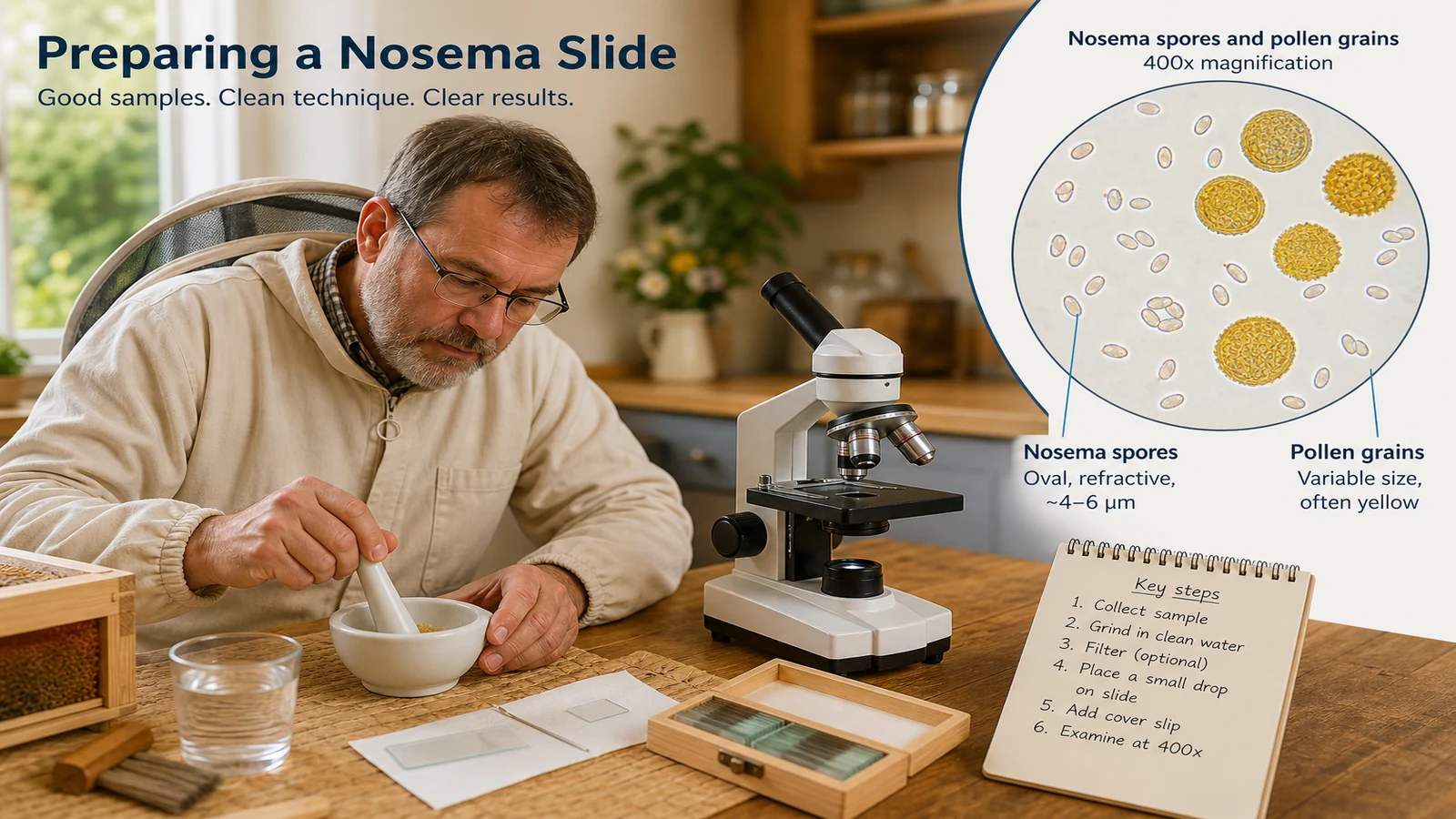
Nosema spores microscope 400x UK beekeeping: kitchen-table compound microscope checklist
If you search for nosema spores microscope 400x uk beekeeping, you usually want a practical answer before spring build-up: can you spot rice-shaped spores at home instead of posting every sample to the National Bee Unit? UK association handouts and microscopy courses commonly use a compound light microscope at about 400× total magnification—typically a 10× eyepiece with a 40× objective—after mashing roughly thirty older worker bees in a little water on a slide.
What 400× nosema screening actually involves
Nosema is a gut disease of adult honey bees. Microscopy does not replace veterinary advice, and Fumidil B is not available in the UK since 2012, so screening is about colony management and hygiene rather than buying treatment from a blog. At 400×, healthy preparation should reveal oval, rice-like spores distinct from round pollen grains. Without a haemocytometer, treat the result as qualitative: enough to decide whether a lab confirmation is worth sending.
Step-by-step slide prep at home
- Sample in autumn or spring when colony strength looks wrong but varroa counts seem acceptable.
- Collect about thirty older foragers from the hive entrance—not nurse bees from brood frames.
- Mash them in a pestle with a few drops of clean water until you have a milky suspension.
- Place a drop on a slide, cover with a coverslip, and remove large debris with a corner of tissue.
- Start on a low-power objective to find the sample area, then rotate to 40× with a 10× eyepiece for 400× total.
Recognition tips and when to involve NBU
Spores appear as uniform ovals in the background soup of tissue. Pollen grains are larger, more angular, and often brightly structured. If you see nothing conclusive, repeat with a fresh sample rather than guessing infection rates. Persistent spring losses, dysentery staining on frames, or association course tutors recommending confirmation are sensible triggers to send material to NBU or an accredited lab rather than relying on kitchen-table counts alone.
Equipment checklist
- Compound monocular or binocular microscope with 4×, 10× and 40× objectives
- LED substage lighting you can dim—bright glare hides small spores
- Glass slides, coverslips, pestle and mortar or small grinding dish
- Mechanical stage helps if you need to scan systematically, but stage clips work for a first pass
- Separate notebook for hive ID, date and qualitative notes—never reuse slides between apiaries unwashed
Compound vs stereo for beekeepers
A low-power stereo microscope is excellent for varroa on a sticky board or inspecting wax moth damage. It will not resolve nosema spores. Many association members keep one shared compound instrument for disease evenings; if your branch queue is always full, a modest home compound model can pay for itself across a few colonies. Compare GCSE practical needs in our onion cells at 400× guide and magnification literacy in empty magnification explained.
Who can skip buying a compound microscope
Casual beekeepers who never attend microscopy evenings and rely on annual association screening do not need their own instrument. If you only inspect brood pattern and varroa, borrow club kit first. Buy when you manage several colonies and want repeat autumn checks without courier delays.
Review the listing if home screening fits your apiary
AdultMonoc lists a monocular biological compound microscope priced at £60.99 on the live product page. We do not claim this SKU includes a mechanical stage or Abbe condenser until the listing publishes those details—verify on the monocular biological microscope page before checkout.
Is 400× enough for nosema in the UK?
Yes for a qualitative screen when association materials and microscopy tutors reference 40× objectives with 10× eyepieces.
Can I treat nosema based on a home slide alone?
No. Use microscopy to decide whether to seek lab confirmation and improve hygiene; do not self-prescribe banned treatments.
Do I need 1000× oil immersion for spores?
Not for an initial nosema pass. Save oil immersion for bacterial work or advanced courses.