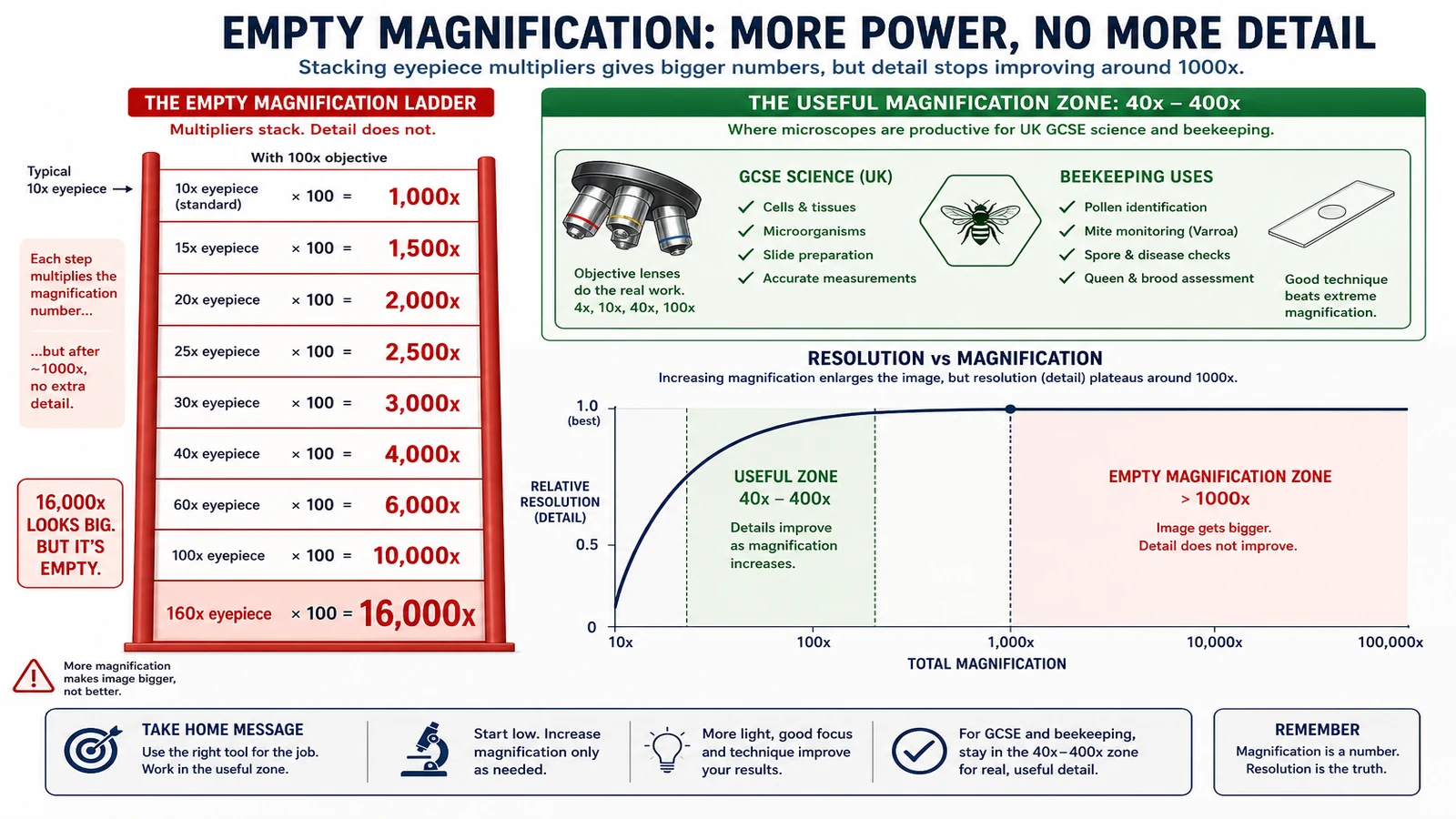
Empty magnification 16000X microscope explained UK: useful 40–400× band for buyers
Empty magnification 16000x microscope explained uk searches spike whenever shoppers see headline numbers like 40–16000× on student compound listings. Empty magnification means you are enlarging the image without resolving new detail—the optical system has hit the limit set by numerical aperture and wavelength. Leica and Nikon educational material commonly cites useful magnification as roughly 500–1000× the objective’s numerical aperture; beyond that, pixels get bigger, not clearer.
Why 16000× appears on packaging
Manufacturers multiply low-power objectives by high-power eyepieces, then sometimes fold in digital zoom or camera crop factors. Mathematically you reach huge totals; biologically you still rely on 40× and 100× objectives for GCSE work, and 400× for onion nuclei or nosema spore screening. Microscope.com and Microscope Club articles describe anything far above ~1000× on a standard compound as marketing headroom rather than new resolution.
What UK learners actually use
| Total magnification (10× eyepiece) | Typical visible detail |
|---|---|
| 40× (4× objective) | Locate slide area, cheek smear sheet |
| 100× (10× objective) | Onion cell outlines, pollen grains |
| 400× (40× objective) | Onion nuclei, cheek nuclei, nosema spores |
| 1000× oil (100× objective) | Bacteria shapes in post-16 labs; not required for GCSE RP01 |
Four pre-purchase checks that matter more than the headline
- Objective set includes 4×, 10× and 40× achromatic lenses with engraved magnification
- 160 mm tube length or manufacturer-stated infinity correction—student models usually follow school standards
- Substage condenser you can raise and iris-down for contrast at 400×
- Rigid focus mechanism that does not drift while students draw
Read feature specifics carefully on any listing you buy—our mechanical stage and Abbe condenser guide explains why condenser type is often omitted from marketing copy.
When to ignore 1000× oil immersion
GCSE onion and cheek practicals stop at 400×. UK beekeepers performing qualitative nosema screens also stop at 400× unless pursuing advanced courses. Oil immersion adds cleaning burden and student risk without helping those tasks.
How to read this shop’s own headline responsibly
AdultMonoc’s monocular biological microscope product page uses a 40X–16000X headline while pricing the unit at £60.99. That range describes marketing span, not a promise that every step resolves new structure. Treat 40–400× as the working band for home GCSE and beekeeping described in our onion practical and nosema screening articles. Confirm current objectives and accessories on the product page before purchase.
Is empty magnification the same as digital zoom?
Related idea: both enlarge without new detail once optical limits are reached.
Should I avoid every microscope above 1000× advertised?
No—check whether usable 4×/10×/40× objectives and lighting are solid; ignore unreachable multiples.
Will a 15× eyepiece help GCSE?
It raises total magnification but can reduce field of view and comfort; 10× eyepieces match school kit.