Mechanical stage Abbe condenser compound microscope UK: GCSE and 400× checklist
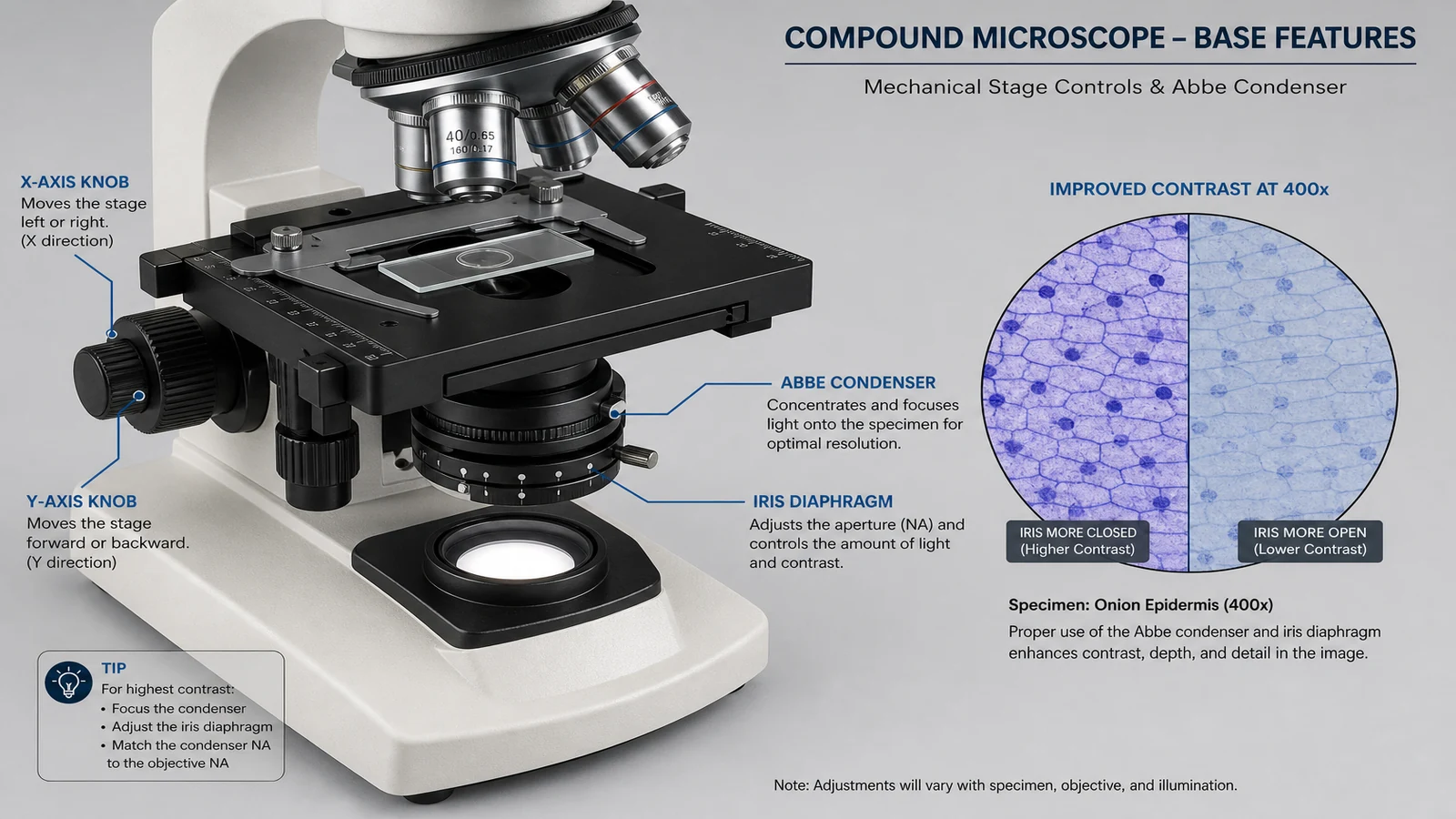
Searches for mechanical stage abbe condenser compound microscope uk usually mean you have read CLEAPSS GL125 or a school supplier guide and now wonder whether a sub-£100 listing actually includes them. Mechanical stages move slides in precise X–Y directions with knobs; Abbe condensers focus substage light through an iris diaphragm so high-power objectives get even illumination. Both matter once you leave 40× and work at 400× for GCSE onion nuclei or beekeeper nosema screens.
What changes when you step up to high power
At 4×, hand-moving a slide under stage clips is tolerable. At 400×, the field is tiny—breathing knocks the spore you wanted out of view. A mechanical stage lets you track horizontally without touching the slide. Meanwhile, an Abbe condenser with iris control prevents washed-out glare that hides oval spores or faint nuclei. Microbus glossary notes condenser numerical aperture should meet or exceed the objective in use for best contrast.
When stage clips are still acceptable
Short GCSE sessions with prepared onion peels can succeed with clips if an adult helps centre the sample on low power before switching objectives. Counting nosema fields across a whole slide is painful without a mechanical stage—association microscopists notice the difference immediately. Treat clips as a budget compromise, not a silent equivalent.
Listing red flags UK buyers see
Many consumer listings shout 16000× magnification but stay silent on condenser type or stage mechanics. That omission does not prove absence, but it does mean you must read specification tables or ask the seller before assuming GCSE-ready hardware. Our empty magnification guide explains why headline multiples distract from these parts.
Eight yes/no checks before checkout
- Are 4×, 10× and 40× objectives listed by name?
- Is there a substage condenser—not just a bare LED plate?
- Does the seller name Abbe or at least iris diaphragm control?
- Is the stage mechanical with X–Y knobs rather than clips only?
- Is fine focus separate from coarse focus?
- Is the lamp dimmable or diffused for contrast work?
- Does the price include eyepieces matching school 10× standards?
- Are oil immersion claims separated from everyday 400× needs?
Tie back to GCSE and beekeeping articles
Onion and cheek practicals at 400× benefit from condenser adjustment—walk through mounts in GCSE onion cells at home and cheek cell prep. Nosema qualitative screening at 400× is easier when you can scan methodically—see nosema spores at 400×. Monocular heads remain valid for these tasks in monocular vs binocular for GCSE.
Honest note on this site’s product page
AdultMonoc lists a monocular biological compound microscope at £60.99 with a 40X–16000X marketing headline. We have not verified whether this SKU ships with a mechanical stage or Abbe condenser—check the live specification section on the monocular biological microscope page and treat unspecific copy as unknown until confirmed.
Does GCSE require a mechanical stage?
CLEAPSS recommends it for sustained slide work; many schools use them, but clips can suffice for brief RP practice with care.
Can I upgrade a condenser later?
Sometimes on modular lab stands; student sealed bases often cannot be upgraded—verify with the seller.
Is Abbe the only condenser type?
Abbe is common in teaching; some advanced models use alternatives, but iris control matters more than the marketing name.